
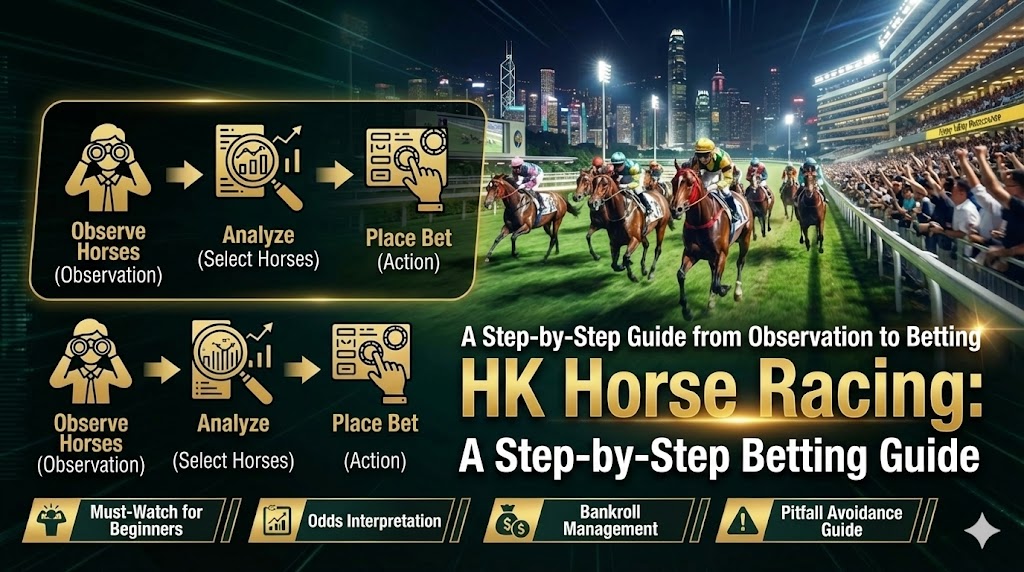
Hong Kong horse racing is more than betting; it’s a discipline of data and judgment. Don’t let the complexity scare you. This guide takes you step-by-step—from reading odds and picking horses to managing funds—helping you build a clear, executable betting strategy.
1.Basic Racing Concepts: Must-Knows for Beginners
Race Types
Hong Kong racing is mainly divided into:
- Turf Races
- All-Weather Track (Dirt) Races
- Note: Turf races place more emphasis on the horse’s form and track bias, while Dirt races are relatively stable and easier for beginners to track trends.
Distances
Common distances include:
- Sprints: 1000m – 1200m
- Middle Distance: 1400m – 1600m
- Stayers (Long Distance): 1800m and above
- Advice: Beginners should start by studying 1200m or 1400m races, as there are fewer variables.
Track & Draw (Gate)
- Inner Draws: Generally advantageous (especially in Sprints).
- Outer Draws: Rely heavily on race pace and the jockey’s skill to overcome the wide position.
2. Guide to Common Betting Types
Win
- Goal: Pick the horse that finishes 1st.
- Pros/Cons: Simplest to understand. Lower hit rate; suitable only when you have high confidence.
Place
- Goal: Pick a horse to finish in the Top 3 (or Top 2 depending on field size).
- Pros/Cons: Most used by beginners. High stability/win rate.
3. Quinella
- Goal: Pick the 1st and 2nd horses in any order.
- Pros/Cons: Balances risk and reward. Great for races with two strong favorites.
4. Quinella Place
- Goal: Pick any 2 horses to finish within the Top 3.
- Pros/Cons: High hit rate. Lower returns, but very stable.
5. Trio/ Tierce
- Note based on text description: Picking 3 horses to finish Top 3 in any order is a Trio.
- Goal: Pick 3 horses to fill the Top 3 spots.
- Pros/Cons: High returns. High difficulty; beginners should not bet heavily on this.
Recommended progression for beginners: Place→ Quinella Place→ Quinella.
3. How to Pick a Horse? Key Analysis Points
Recent Form
Look at performance in the last 3–5 races:
- Is it consistently finishing in the Top 4?
- Did it have valid excuses for losing (e.g., bad draw or slow pace)?
Jockey & Trainer
- Strong Combinations: Certain jockey/trainer partnerships are worth extra points.
- Trainer Strategy: If a trainer sends multiple horses into the same race, identify which one is the “Main” contender.
Track Aptitude (Course & Distance)
- Some horses only run well on Turf; others excel on Dirt.
- C&D Record: If a horse has performed well on the Same Course and Same Distance, this is a major plus factor.
Odds Movement
- Sharp Drop (Brown Lamp): Indicates strong market confidence/heavy betting.
- Drifting Odds: Be careful with horses that stay “cold” (high odds) for a long time.
4. Betting Rhythm & Bankroll Management
Split Stakes (Unit Betting)
Do not go “All-in” on one race.
- Rule: Use maximum 5%–10% of your total bankroll per race.
- Strategy: Spread your bets across multiple opportunities.
Race Selection
You don’t need to bet on every race. Choose races where:
- Data is clear.
- Horses are evenly matched, but there is a clear “Banker” (favorite).
Mindset Management
- Do not increase stakes when losing (Don’t chase losses).
- Do not get greedy when winning.
- Reality Check: Horse racing is a long-term game, not a “do or die” single event.
5. Common Mistakes & Pitfalls to Avoid
- ❌ Only looking at odds without analyzing the horse.
- ❌ Following tips blindly without doing homework.
- ❌ Chasing losses immediately after a bad race.
- ❌ Using high-risk bets (like Tierce/Trio) as the main strategy.
The Correct Approach:
- ✅ Use Place and Quinella Place as your core strategy.
- ✅ Only participate in high-odds bets with small change (small stakes).
6. Build Your Own System
People who are truly successful at racing don’t rely on luck; they have a fixed process. For example:
- Select: Pick only 2–3 races you feel confident in.
- Pick: Choose 1 Main Horse + 1 Secondary Horse per race.
- Bet: Focus on Place / Quinella Place.
- Discipline: Set a strict Stop-Loss limit.
When you use the same logic over the long term, you will see your strengths and weaknesses and be able to continuously adjust your strategy.